
Political Ideas.
2024
LOCATION
CPAC HQ – WASHINGTON D.C.

THE IDEAS
PLANS AND PROPOSALS
Eduardo Bittar’s “Venezuela’s Second Independence Plan” is a policy framework designed to overthrow the Castro-Chavista regime in Venezuela and facilitate national restoration through a structured civic-military alliance. Central to the proposal is the understanding of the “Historical Problem“, and the joining civilian activists and military to execute a “counterrevolution” to the system, which Bittar argues cannot be dismantled through electoral or institutional means.
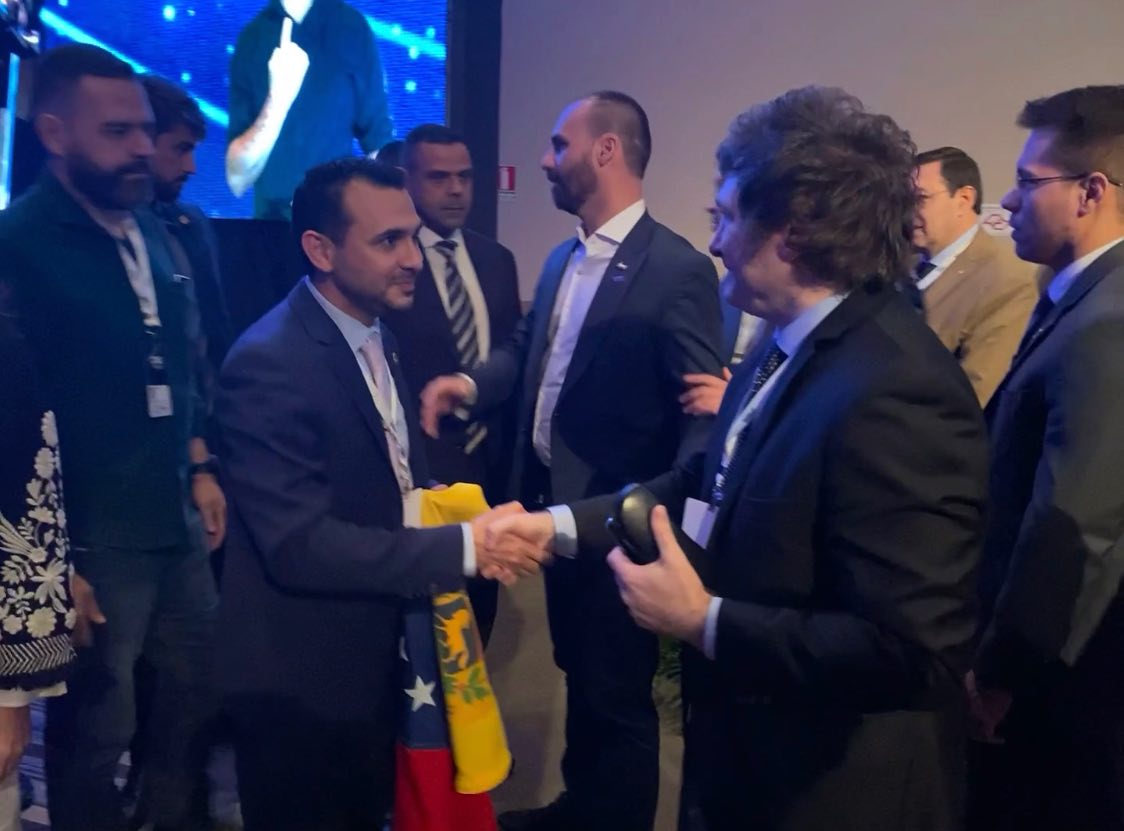
The plan was publicly advanced in late August 2024, when Bittar accepted an invitation to meet exiled Venezuelan forces in Argentina on September 3, aiming to operationalize the framework amid the disputed July 28 presidential elections. The reception included endorsements from participating military exiles, positioning the initiative as a collaborative effort to restore sovereignty.
Theoretically, the “Venezuela’s Second Independence Plan” draws on libertarian principles of limited government and opposition to the partisan control, adapted to Venezuela’s crisis by prioritizing decisive action over prolonged diplomatic negotiations It reflects Bittar’s broader advocacy for individual freedoms and system change, tailored to counter the entrenched socialist power structures.


THE ACTIONS
Critique of oppo-fiction and Controlled Opposition
Eduardo Bittar has coined the term “OPPO-FICTION” to describe what he views as a fabricated opposition in Venezuela, engineered by Hugo Chávez to perpetuate regime control through illusory resistance narratives that align with Marxist-progressive ideals rather than challenging them. He also coined the term “CHAVISMUD” which composes the terms “Chavismo” and the acronym “MUD” (Mesa de la Unidad Democrática), where the latter represents the opposition coalition. According to Bittar, these concepts encapsulate a controlled opposition that emerged after Chávez’s 1998 rise, morphing pre-existing left-wing structures into mechanisms that crush genuine uprisings while obeying the regime’s agenda.
Bittar applies “OPPO-FICTION” to specific figures, such as Ms. María Corina Machado, whom he points out is responsible of enacting gun banning laws in coordination with regime congressmen who pass them unanimously, thereby weakening potential resistance and leaving people defenseless. He further criticizes her involvement with the Socialist International organization, framing these actions as evidence of complicity in a broader pattern where opposition leaders pose as saviors—”clown messiahs”—while undermining authentic efforts against Chavismo.
In Bittar’s point of view, this controlled opposition perpetuates the regime by diverting international support and resources away from true patriots who have engaged in street-level resistance for over a decade, insisting that continued backing of such “traitors” ensures the problem’s persistence. In this sense, the “OPPO-FICTION” must be dismantled to enable real liberation, as it defends anti-virtues and blocks paths to overthrowing the tyranny.
Feedback
— X SOCIAL MEDIA COMMENTS
“To every Venezuelan patriot: we have the moral obligation to bury socialism and its accomplices… The only patriotic, conservative option that upholds the national ideal is found under the political leadership of Eduardo Bittar. We have no fear: it is Freedom or Nothing.”
Explore More Work
Background
Background
Venezuelan Politics
Venezuelan Politics
International Alliances
